

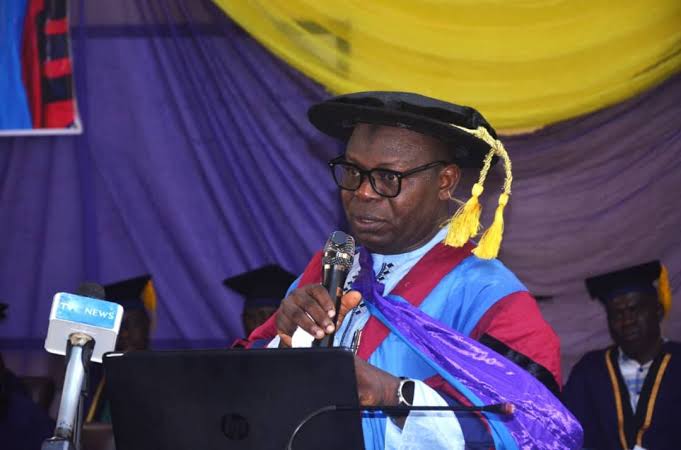
The Vice-Chancellor of Confluence University of Science and Technology (CUSTECH), Osara, Prof. Abdulrahman Asipita Salawu, has called for a deliberate shift from the export of raw mineral resources to value addition and local manufacturing as a strategy for unlocking Nigeria’s industrial and economic potential.
Prof. Salawu made the call while delivering the 133rd Inaugural Lecture of the Federal University of Technology, Minna, Niger State.
The lecture, titled “Nature to Nature: The Mirage of Materials Longevity,” examined the life cycle of engineering materials, from their extraction and processing to degradation through corrosion and other environmental interactions.
Salawu who is a Professor in the Department of Materials and Metallurgical Engineering, School of Infrastructure, Process Engineering and Technology at the University and currently on leave of absence as the second substantive Vice Chancellor of CUSTECH, Osara, emphasised the strategic importance of Materials and Metallurgical Engineering in Nigeria’s industrial development.
According to him, professionals in the sector have a critical role to play in exploring and processing the country’s abundant mineral resources and converting them into finished and semi-finished products for domestic consumption and export.
He expressed concern over Nigeria’s longstanding dependence on the export of raw materials and the importation of finished products, noting that the practice undermines local industries, limits employment opportunities and weakens the country’s capacity for sustainable economic development.
He advocated increased investment in sustainable mineral processing, corrosion and wear testing, advanced biomaterials, as well as stronger collaboration between universities, research institutions and industries.
Drawing extensively from his research experience, Prof. Salawu highlighted significant work in mineral beneficiation, corrosion control, green corrosion inhibitors, composites, nanocomposites, construction materials and biomaterials as evident in the processing of Nigerian iron, manganese and gold ores; the use of environmentally friendly borax in gold extraction; the production of asbestos-free brake pads from agricultural waste; and the development of anti-corrosion coatings for pipelines, storage tanks and other critical infrastructure.
He also highlighted research into locally sourced biomaterials and biocomposites with potential applications in bone repair and biomedical implants, as well as innovative approaches to converting agricultural and industrial waste into useful engineering materials.
The Vice-Chancellor emphasised that Nigeria’s universities must go beyond generating knowledge by ensuring that research outcomes are translated into practical technologies capable of solving real-world industrial problems.
He also called for a stronger and more sustained partnership among universities, researchers, government and industry, stressing that such collaboration would accelerate technology transfer, promote innovation and strengthen Nigeria’s industrial base.
Prof. Salawu urged the country to move decisively from a raw-material-exporting economy to one driven by value addition, local production and technology-based industrialisation.
He maintained that harnessing Nigeria’s vast natural resources through scientific research, innovation and local manufacturing would create jobs, reduce dependence on imported products, promote economic self-reliance and place the country on a stronger path to sustainable development.
Vice-Chancellor of the Federal University of Technology, Minna, Prof. Faruk Adamu Kuta, presented a certificate and plaque to Prof. Salawu in recognition of his contribution to knowledge and scholarship.
The occasion also featured the presentation of gifts to the inaugural lecturer by professional organisations, colleagues, friends and well-wishers.
The inaugural lecture was attended by distinguished academics, policymakers, industrialists, Kogi State Government officials, Ohinoyi of Ebiraland, His Royal Majesty,Alh.Muhammed Ahmed Tijani Anaje, and other stakeholders who came to celebrate the scholarly achievement and contributions of the CUSTECH Vice-Chancellor to the development of materials and metallurgical engineering in Nigeria.