

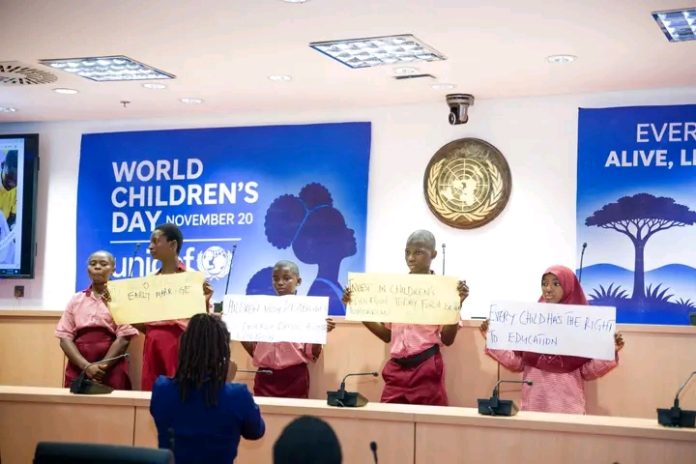
Nigerian children have called on government, development partners, the private sector, and communities to make stronger choices and investments to ensure that every child can survive, thrive, and learn, as the country marked World Children’s Day in Abuja.
At a child-led event held at the United Nations House under the theme “Every Child Alive, Thriving and Learning: A Shared Responsibility,” children took centre stage, speaking directly about the issues affecting their lives and putting their questions to government officials, development partners, and other experts.
The conversations focused particularly on giving every child the best start in the first 1,000 days of life, from pregnancy to a child’s second birthday, and tackling the barriers that continue to keep millions of Nigerian children out of school.
Children challenged adults on what needs to change, from better access to health and nutrition services for mothers and young children to ensuring that poverty, location, gender, or disability do not determine whether a child has the opportunity to learn.
Children and young people at the event also shared, through panel discussion and “Ask the Expert” sessions, what they need the government and all stakeholders to survive, thrive, and learn, while poetry, school presentations, an open-mic session, and other child-led activities gave them space to speak about the future they want.
Goodwill messages from government, the donor community, civil society, and other partners reinforced the need for collective action and sustained investment in the Nigerian children, recognizing the progress being made so far but that there is still room for a lot more to be done and that progress for children cannot be delivered by one institution or sector alone.
UNICEF Deputy Representative, Operations, Charles Lolika, speaking on behalf of UNICEF Country Representative Wafaa Saeed, who was unavoidably absent, said the day was an important reminder that children must not only be at the center of decisions about their future but must also have a voice in shaping those decisions.
“Today, we heard directly from children about the Nigeria they want to grow up in. They want to be healthy and well nourished. They want to be safe. They want to learn and have the opportunity to fulfill their potential. These are not privileges we give to children; they are their rights, and delivering them is a responsibility we all share,” said Charles Lolika.
He called for the conversations from World Children’s Day to translate into concrete decisions and investments for children.
“Listening to children is important, but listening must lead to action. The choices we make in our budgets, policies, communities, and homes determine whether a child gets the right start in life, whether that child enters and stays in school, and ultimately the future that child can build. We must choose children, and we must choose them now,” he added.
This year’s World Children’s Day also marks the beginning of a significant moment for UNICEF as the organization approaches its 80th anniversary on 11 December 2026 World Children’s Day serves as the soft launch of @UNICEF80 and its global call to action, “Choose a Future for Children.”