

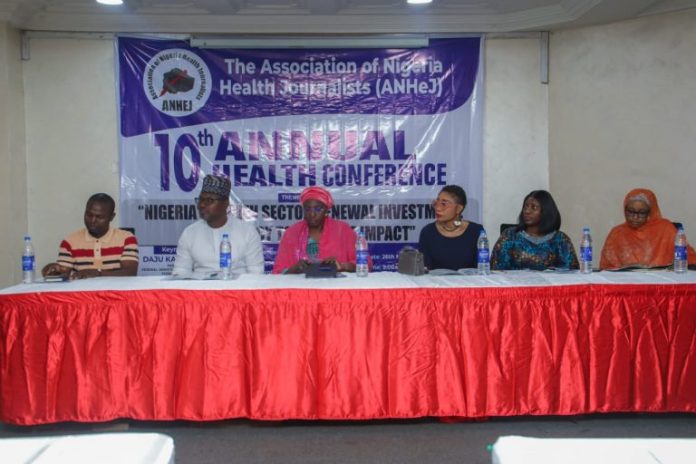
The Federal Government has declared Nigeria free of Ebola following more than 21 days without a new confirmed case, while raising concerns over high healthcare costs, limited insurance coverage and poor implementation of health sector reforms across states.
The Permanent Secretary, Federal Ministry of Health and Social Welfare, Daju Kachollom, disclosed this on Thursday in Abuja at the 10th Annual Conference of the Association of Nigerian Health Journalists (ANHeJ).
She also revealed that 10 states scored below 40 per cent in implementing resolutions of the National Council on Health, highlighting gaps between government policies and the delivery of healthcare services.
On the Ebola outbreak, Kachollom said Nigeria had recorded no new confirmed cases for more than 21 days after detecting an imported case. She commended journalists for their role in communicating public health information during the outbreak.
She said the ministry adopted transparent communication to keep Nigerians informed, stressing that journalists must verify information before publication to avoid spreading misinformation and creating unnecessary panic during disease outbreaks.
Delivering a keynote address titled, ‘Nigeria’s Health Sector Renewal Investment: From Policy to Tangible Impact’, Kachollom said 12 of the 13 indicators tracked under the Nigeria Health Sector Renewal Investment Initiative (NHSRII) had improved, while all 41 presidential commitments on health sector reforms had been achieved.
She said 3,526 primary healthcare centres had been revitalised, with another 900 undergoing rehabilitation. Skilled deliveries also increased from 4.8 million in 2023 to 7.9 million by mid-2026.
According to her, maternal deaths declined by 17 per cent and newborn deaths by 12 per cent between 2023 and 2025 in 172 local government areas.
She added that 100 million children had received measles and rubella vaccines, while more than 17 million girls had been vaccinated against human papillomavirus (HPV).
Kachollom said health insurance enrolment had increased from about 16 million to nearly 24 million, while state health budgets rose from ₦1.97 trillion in 2023 to more than ₦3.3 trillion in 2026.
She also disclosed that 10 factories and manufacturing lines had been commissioned to expand local production of medicines, diagnostic products, mosquito nets and medical oxygen.
Despite the progress, the permanent secretary identified weak implementation at the state level as a major challenge, noting that the ministry received only 412 of the 740 reports expected on resolutions reached at the previous National Council on Health meeting.
Ten states, she said, recorded implementation scores below 40 per cent.
“A resolution that is never implemented is just another announcement,” she said.
She further acknowledged that healthcare remained unaffordable for many Nigerians, with insurance coverage reaching only about one in 10 people. She also identified the uneven distribution of health workers and childhood malnutrition as persistent challenges, noting that about four in every 10 children under five suffered from stunting.
Kachollom urged journalists to go beyond reporting government announcements by visiting health facilities and independently assessing the impact of public investments on healthcare delivery.
Also speaking, the Programme Manager and Oncology Lead at the Institute of Human Virology Nigeria, Dr Victoria Igbinomwanhia, called for stronger collaboration between health institutions and journalists to promote evidence-based reporting and counter misinformation.
The Health Systems and Business Development Lead at the Africa Health Budget Network, Khadija Bobboyi, urged journalists to demand increased domestic investment in healthcare and greater budget accountability. She also advocated the inclusion of young people, women and persons with disabilities in health policy discussions.
The President of the Nigerian Cancer Society, Prof. Abidemi Omonisi, represented by Chukwuma Matthew, called for increased government investment in cancer prevention, early detection, diagnosis, treatment and palliative care.
He stressed the need for sustained funding, accessible healthcare facilities and skilled personnel, urging journalists to promote screening, early presentation and efforts to address cancer-related stigma.
Earlier, ANHeJ President, Joseph Kadiri, called for stronger accountability in the health sector, saying government reforms and investments should be measured by reductions in maternal and child deaths, improved access to quality healthcare, affordable medicines and functional primary healthcare facilities.
He said the association would continue working with the Basic Healthcare Provision Fund gateways and the Ministerial Oversight Committee to monitor health interventions through visits to states and healthcare facilities.