

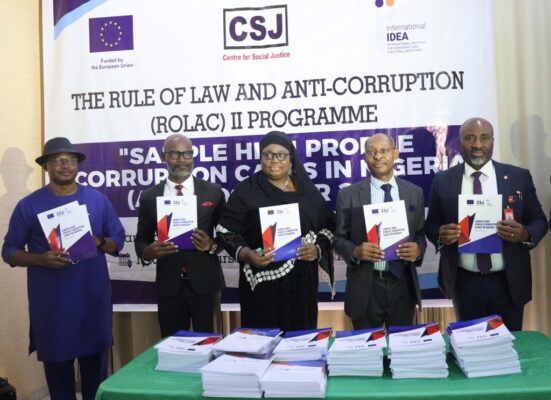
The Economic and Financial Crimes Commission (EFCC) has called for stronger collaboration among justice sector stakeholders to speed up the prosecution of corruption cases and address delays in Nigerian courts.
The EFCC Chairman, Ola Olukoyede, made the call on Thursday in Abuja at the presentation of a report titled, “Sample High Profile Corruption Cases as at October 2026,” organised by the Centre for Social Justice (CSJ).
Olukoyede, who was represented by his Chief of Staff, Michael Nzekwe, said tackling delays in corruption trials required the cooperation of the judiciary, legislature, legal practitioners, civil society organisations and other institutions involved in the administration of justice.
The commission disclosed this in a statement shared on its social media platforms on Friday.
He identified frequent adjournments, interlocutory proceedings, difficulties in securing witnesses, delays in obtaining documentary evidence, congested court schedules and reassignment of part-heard cases as factors slowing down corruption trials.
He said the delays increased the cost of prosecution and defence while leaving defendants, victims and institutions in prolonged uncertainty.
Olukoyede said the commission remained committed to investigating and prosecuting economic and financial crimes without fear or favour, in line with the rule of law.
He disclosed that the EFCC was strengthening its internal processes to ensure thorough investigations, properly prepared charges, preservation of evidence and adequate preparation of witnesses before cases were taken to court.
He also stressed the need for closer cooperation between investigators and prosecutors from the early stages of complex investigations.
The EFCC chairman added that the commission was investing in digitisation, forensic capabilities and staff development to improve investigations and reduce avoidable delays.
Earlier, the Director of the Centre for Social Justice, Eze Onyekpere, said the report was produced under a project titled, “Improving the Effectiveness of Anti-Corruption Processes and Reforms in Nigeria.”
He said the project, supported by the European Union, IDEAS and the Rule of Law and Anti-Corruption (RoLAC 2) project, was aimed at improving anti-corruption laws, policies and strategies while promoting reforms at national and subnational levels.
Representatives of the Code of Conduct Bureau, Code of Conduct Tribunal, Nigerian Law Reform Commission, Nigerian Bar Association, civil society organisations, the media and other stakeholders in the anti-corruption sector attended the event.