

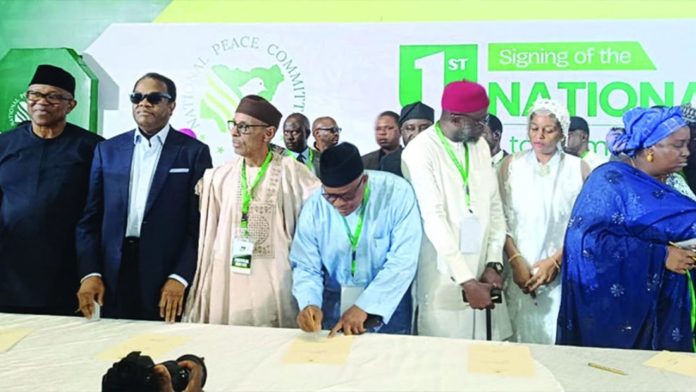
Presidential candidates and political parties have expressed mixed reactions to the National Peace Accord signed ahead of the commencement of campaigns for the 2027 general elections, with some opposition figures questioning whether the pact will translate into actual compliance.
The accord was signed on Tuesday in Abuja, one day before the official commencement of public campaigns and rallies for the presidential and National Assembly elections.
The ceremony was organised by the National Peace Committee in partnership with The Kukah Centre and brought together presidential candidates, political party leaders, representatives of the Presidency and National Assembly, the Independent National Electoral Commission (INEC), security agencies, civil society organisations and members of the diplomatic community.
Among those who signed the accord were presidential candidates Peter Obi of the Nigeria Democratic Congress, Omoyele Sowore of the African Action Congress, Adewole Adebayo of the Social Democratic Party, Donald Duke of the Peoples Redemption Party, Aliyu Bin Abbas of the Action Democratic Party and Chibuzo Okereke of the Labour Party.
President Bola Tinubu, the All Progressives Congress presidential candidate, was represented at the event by the Secretary to the Government of the Federation, George Akume.
However, the presidential candidate of the African Democratic Congress, Atiku Abubakar, and some other notable political figures were absent.
The agreement commits political parties and candidates to peaceful and issue-based campaigns while rejecting violence, hate speech, personal attacks, misinformation, disinformation and ethnic or religious incitement.
Despite the commitments, some opposition candidates questioned the effectiveness of the accord, pointing to the failure of previous agreements to completely prevent electoral violence and violations during election periods.
Obi questioned the need for the accord if political actors would not honour its provisions, while Sowore reportedly expressed scepticism based on the experience of previous peace agreements.
Adewole Adebayo also argued that the pact would have little meaning without justice and proper enforcement.
The concerns come as campaigns officially begin on Wednesday, August 19, 2026, with the 2027 presidential and National Assembly elections scheduled for January 16, 2027. Governorship and State House of Assembly elections are scheduled for February 6, 2027.
Speaking at the ceremony, INEC Chairman, Professor Joash Amupitan, urged political parties and candidates to make the campaign a “marketplace of ideas” rather than a “theatre of war.”
Amupitan called on candidates to focus on their policies and explain to Nigerians how they intend to address challenges in areas such as the economy, security and education.
He also warned against misinformation, disinformation, foreign information manipulation and premature victory declarations.
Former Head of State and Chairman of the National Peace Committee, General Abdulsalami Abubakar, also urged political actors to avoid character assassination, inflammatory rhetoric, insults and fake news during the electioneering period.
Tinubu, through Akume, urged political actors to place national interest above personal and partisan ambitions, stressing that the 2027 election should not be treated as a do-or-die affair.
With campaigns now underway, attention will shift to whether the candidates and their supporters will abide by the commitments contained in the accord as political competition intensifies across the country.