

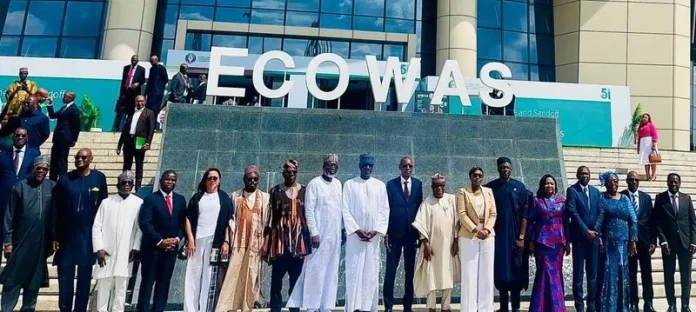
The newly appointed President of the Economic Community of West African States (ECOWAS) Commission, Birame Diop, has pledged to restore cohesion within the regional bloc and deepen cooperation with the Alliance of Sahel States (AES).
Diop made the pledge on Monday in Abuja during the formal handover ceremony of the ECOWAS Commission Management Team at the organisation’s headquarters.
He said the Commission was assuming office at a critical time, particularly following the withdrawal of Burkina Faso, Mali and Niger from ECOWAS.
Diop, however, stressed that the geographical proximity and shared security and development challenges between ECOWAS and the three countries made continued cooperation necessary.
According to him, Burkina Faso, Mali and Niger remain neighbours and brothers to ECOWAS member states despite their withdrawal from the organisation.
“Geography remains the same,” he said, noting that both blocs faced common challenges, including terrorism, irregular migration, organised transboundary crime and environmental degradation.
Diop said ECOWAS and AES shared about 5,250 kilometres of borders, making cooperation essential in the interest of citizens across the region.
“We have no other choice than to work in a solidary, concerted manner for the interest of both spaces,” he said.
He also pledged to work with Senegal to address the political crisis in Guinea-Bissau, following the decision by ECOWAS Heads of State and Government to designate Senegal as facilitator.
The new president identified strengthening internal cohesion and improving the effectiveness of ECOWAS institutions as key priorities of his administration as the organisation implements its Vision 2050 agenda.
He noted that ECOWAS had designed more than 50 programmes but needed adequate funding to implement them effectively.
Diop called for innovative financing mechanisms to address the organisation’s financial constraints and ensure that its programmes delivered tangible results.
He also urged staff and member states to embrace tolerance, patience, respect and solidarity, stressing that differences in history and culture should not undermine regional unity.
Diop was appointed President of the ECOWAS Commission at the 69th Ordinary Session of the Conference of Heads of State and Government held in July.
The outgoing President of the ECOWAS Commission, Dr Aliou Omar Touré, formally handed over to Diop after four years in office.
Touré said his administration delivered several programmes despite challenges faced by the regional organisation, including the withdrawal of Burkina Faso, Mali and Niger.
He cited progress in regional infrastructure and connectivity projects, including the African Atlantic Gas Pipeline and the Abidjan-Lagos Corridor Highway.
He also highlighted developments in electricity interconnection, economic and monetary integration, food security, youth and women empowerment, education and skills development.
Touré said preparations for the ECO single currency had advanced, with ECOWAS leaders resolving to launch the currency in 2027.
He disclosed that the West Africa Rice Investment Roundtable generated an investment pipeline of about $1.54 billion, including $1.47 billion in firm commitments.
He also cited the completion and occupation of the new ECOWAS Headquarters Complex in Abuja, supported by the Government of China, and the completion and inauguration of the ECOWAS Logistics Depot for peace and support operations in Sierra Leone.
According to him, his administration also oversaw the closure and transfer of ECOWAS community assets and offices following the withdrawal of the three countries.
Touré said the Commission introduced a new post-adjustment mechanism across all duty stations, resulting in salary increases for regular staff and some categories of contract workers.
“An institution cannot demand excellence from its people while remaining indifferent to their welfare,” he said.
Touré urged the new leadership to keep ECOWAS people-centred, noting that citizens experienced the organisation through free movement, trade, employment, security and economic opportunities.
Nigeria’s Minister of State for Foreign Affairs, Ambassador Sola Enikanolaiye, urged the new ECOWAS leadership to strengthen regional integration, accountability and financial discipline.
Enikanolaiye, who represented President Bola Tinubu at the ceremony, reaffirmed Nigeria’s commitment to the progress, stability and development of ECOWAS.
He called on the new management to promote cost-effectiveness, prudent financial management and value for money in the operations of the Commission and other ECOWAS institutions.
“For Nigeria, ECOWAS must continue to justify the huge investments and sacrifices that have been made, not just by the government and people of Nigeria, including the payment of community levy, but also by other member states in the sub-region to sustain the organisation,” he said.
The minister also called for renewed attention to peace and security, warning that economic integration could not thrive amid political instability, terrorism, violent extremism, irregular migration, banditry and climate-related challenges.
He urged the new leadership to deepen engagement with the AES countries, describing them as “our brothers and sisters in our shared region and with common challenges and aspirations.”
Enikanolaiye further tasked the management with ensuring that ECOWAS programmes produced direct and measurable benefits for citizens through free movement, regional trade and investment, infrastructure development, innovation, food and energy security, and employment opportunities for young people and women.
He assured the new leadership of Nigeria’s continued cooperation towards building a stronger, more integrated and people-centred ECOWAS.