

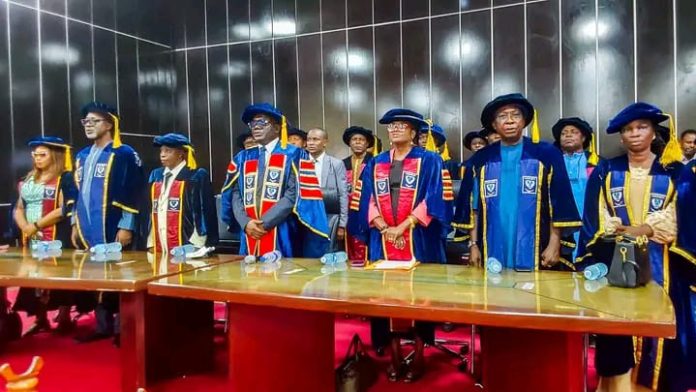
The Federal University Lokoja (FUL) has called for regular water quality testing to prevent waterborne diseases and protect public health.
The call was made at the university’s 47th inaugural lecture held on Wednesday at the Multipurpose Hall, Felele Campus.
The lecture was the third delivered by the Department of Geography and the first from the Faculty of Environmental Sciences.
A Professor of Geography and Environmental Resources Management in the Department of Geography, Prof. Samuel Ibrahim , delivered the lecture titled “Water Is Life, But Is Our Water Living? Confronting the Water Quality Crisis in Nigeria’s Environment.”
He explained that the availability of water does not necessarily mean it is safe for drinking, noting that apparently clear water could contain harmful chemicals and disease-causing organisms.
He said contamination could also occur during collection, transportation and household storage, making regular testing necessary to determine water quality.
Drawing on his research in Niger and Kogi States, Ibrahim examined water quality challenges in urban and rural communities, reservoirs and flood-prone areas.
His studies covered domestic water sources in Minna, groundwater pollution in Lapai, heavy metals in the Lapai and Agaie reservoirs, and the relationship between seasonal flooding and health in Ganaja, Lokoja.
He noted that water quality varies according to its source, location, land use and season, adding that shallow wells are more exposed to surface contamination, while boreholes are not automatically safe because they draw water from underground.
The professor identified poor sanitation, population growth, urbanisation, industrial activities, mining, flooding and weak environmental management as factors contributing to water contamination.
Despite the country’s abundant water resources, he said millions of Nigerians still lack reliable access to safe and affordable drinking water.
He noted that many households depend on private boreholes, water vendors and sachet water, often at considerable cost.
Ibrahim called for a shift from measuring progress by the number of boreholes and other water facilities provided to assessing whether the water supplied meets acceptable quality standards.
He proposed four approaches to addressing the challenge: Integrated Water Resources Management, the use of geospatial technology and remote sensing to monitor water quality, community-based water safety plans, and stronger enforcement of environmental regulations.
He also recommended routine water testing, improved protection of wells and boreholes, enforcement of industrial standards, and the integration of water safety into flood management and climate change adaptation.
The professor further called for interdisciplinary research and public education on water treatment, safe storage, hygiene and waste disposal.
In his remarks, the Vice-Chancellor, Prof. Gbenga Ibileye, said the lecture raised important questions about water supply at the university, particularly given the resources committed to providing water on its campuses.
He noted that despite the university’s location at the confluence of the Niger and Benue rivers, Lokoja and its campuses still experience water scarcity.
By: Favour Olushola