

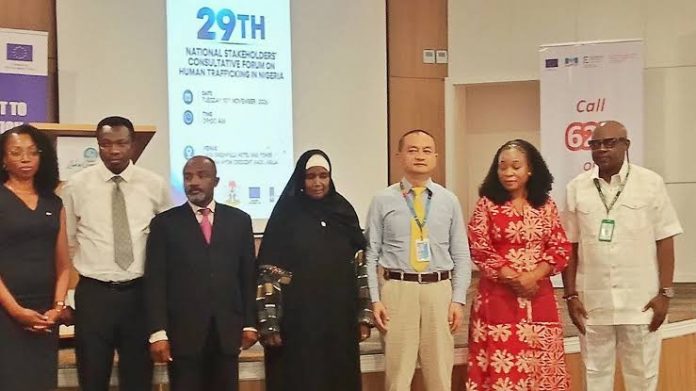
The Federal Government has called for stronger intelligence sharing, collaboration among states and technology-driven interventions to dismantle emerging cyber-enabled human trafficking networks.
The Attorney-General of the Federation and Minister of Justice, Prince Lateef Fagbemi (SAN), made the call at the opening of the 29th National Stakeholders’ Consultative Forum on Human Trafficking, held in Abuja.
The forum was organised by the National Agency for the Prohibition of Trafficking in Persons (NAPTIP) in collaboration with the United Nations Office on Drugs and Crime (UNODC), with funding from the European Union.
Represented by the Acting Director, Citizens Rights Department, Haliru Kabiru, Fagbemi said criminal syndicates were increasingly exploiting digital platforms, social media and online recruitment portals to deceive and exploit vulnerable citizens.
He stressed that real-time intelligence sharing and technological integration were essential for the early identification of trafficking networks and protection of victims.
According to him, the evolving methods of human trafficking require increased public awareness, improved intelligence gathering and stronger cooperation among law enforcement agencies and relevant institutions.
Fagbemi urged state governments and Ministries, Departments and Agencies (MDAs) to incorporate anti-trafficking measures into their operational budgets, noting that no state was immune to the menace.
He added that effective local engagement and robust intelligence networks were necessary to combat transnational and cyber-enabled trafficking syndicates.
Also speaking, the Director-General of NAPTIP, Binta Adamu Bello, disclosed that the agency received 1,508 trafficking cases and made 1,434 arrests between August 2025 and the period of the forum.
She said NAPTIP also rehabilitated 2,700 victims and secured 74 court judgments, resulting in the conviction of 97 offenders within the period.
Bello added that the agency’s cumulative record since inception had reached 28,762 rescued victims and 857 convictions.
She noted that trafficking syndicates were increasingly exploiting digital platforms, online scam networks and deceptive recruitment portals, requiring more proactive intelligence gathering and surveillance.
According to her, the agency had intensified efforts to identify and disrupt trafficking networks operating both online and offline, with particular attention to cyber-enabled trafficking, deceptive online recruitment and emerging forms of exploitation.
The NAPTIP boss urged state governments and relevant agencies to increase funding, strengthen local task forces and institutionalise reliable data systems, including the National Human Trafficking Dashboard.
She said these measures were necessary to address cross-border and technology-facilitated exploitation as the current National Action Plan (2022–2026) approaches the end of its implementation cycle.
The Country Representative of UNODC, Cheikh Toure, commended Nigeria’s collaborative approach to combating human trafficking, describing the forum as an important platform for peer review and coordination among federal and state institutions and civil society organisations.
Represented by the UNODC Operations Manager, William Wu, Toure stressed that reliable data, subnational engagement and victim-centred protection remained essential to addressing emerging trafficking vulnerabilities.
He said comparable data was necessary for understanding trafficking trends, identifying emerging risks and informing policy and operational decisions.
Also speaking, the Swiss Ambassador to Nigeria, Patrick Egloff, said digital tools could improve the verification of employment offers and coordination of cross-border rescue operations.
However, he cautioned that technology-driven anti-trafficking interventions must remain human-centred, with privacy, data protection and the dignity of survivors guiding their implementation.