

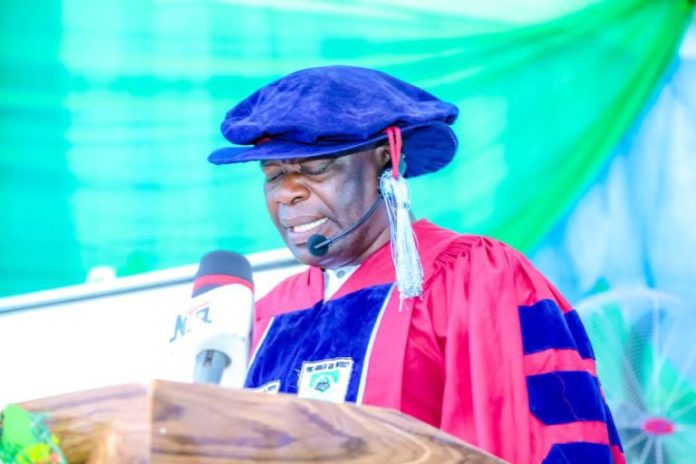
A Professor of Accounting at Prince Abubakar Audu University (PAAU), Anyigba, Professor Sani Rufai Abdullahi, has called for stronger institutions, ethical leadership and value-based governance to deepen accountability, rebuild public trust and promote sustainable national development.
Professor Abdullahi made the call on Tuesday while delivering the university’s 24th Inaugural Lecture, titled “Epistemology of Accountability: Societal and Religious Concerns,” at the school auditorium.
He described accountability as the foundation of trust, justice, transparency and responsible leadership, stressing that it should extend beyond compliance with laws to embrace integrity, stewardship and ethical responsibility.
The scholar, identified transparency, answerability and enforcement as the core pillars of accountability, noting that corruption, weak institutions, conflicts of interest, technological disruption and declining moral values remain major obstacles to good governance.
He further urged governments to strengthen anti-corruption agencies, empower regulatory institutions and adopt digital governance tools, including open-data platforms and blockchain technology, to improve transparency.
Professor Abdullahi also advocated the integration of ethics, civic responsibility and moral education into school curricula, while calling on religious organisations to reinforce teachings on honesty, stewardship and justice. According to him, accountability is both a societal obligation and a moral imperative that requires collective commitment from governments, educational institutions, civil society, religious bodies and citizens.
In his remarks, the Vice-Chancellor of PAAU, Professor Salisu Ogbo Usman, described the lecture as timely and relevant, saying it underscored the link between accounting, ethics, religion and public governance.
The event featured the presentation of an inaugural lecture certificate, plaque and medal to Professor Abdullahi and was attended by members of the university community, government officials, professional accountants, scholars, religious and traditional leaders.