

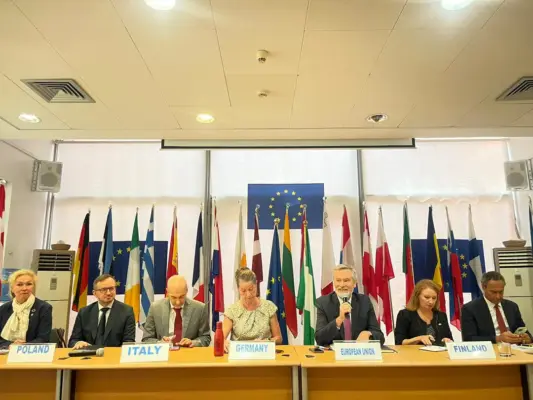
The European Union (EU) has reaffirmed its commitment to supporting Nigeria’s efforts to combat banditry, insecurity, and humanitarian challenges across the country.
This was disclosed by the EU Ambassador to Nigeria and ECOWAS, Gautier Mignot, during an end-of-year media briefing on the bloc’s engagements and achievements in Nigeria held on Wednesday, in Abuja.
Speaking at the event, Mignot noted that insecurity in Nigeria has remain a major concern, stressing that the situation has continued to attract global attention for “good reasons.”
He emphasised that issues such as poverty, social inequality, and severe malnutrition, particularly in the North-West and North-East require urgent humanitarian response.
“But there are others like poverty and social inequalities. We also have been insisting very much on the need to urgently tackle with humanitarian and life-saving assistance the malnutrition crisis affecting, particularly, hundreds of thousands of children in north-west and north-east,” he said.
He added that the protection of all vulnerable groups, including minorities and internally displaced persons (IDPs), remains a priority for the EU, recalled the bloc’s intervention after the Yelwata killings in Benue State earlier in the year.
“In the north, we have launched a northern package of some €300 million of Team Europe funding. The EU stands with the populations affected by a humanitarian crisis, particularly children and women in the north-west and north-east,” he said.
Mignot further revealed that the EU has committed nearly €50 million this year alone to address Nigeria’s worsening malnutrition crisis.
Speaking on the sidelines of the briefing, he noted that Nigeria’s insecurity is a multi-layered challenge with diverse triggers.
“Religion is one, but it’s not the only one,” he said, stressing that while freedom of religion must be upheld, other root causes including economic, social, and environmental factors must also be tackled.
He reaffirmed that the EU continues to support Nigeria through both kinetic and non-kinetic approaches, adding that the 300 million euro northern package represents a comprehensive response aimed at addressing insecurity and its underlying drivers.