

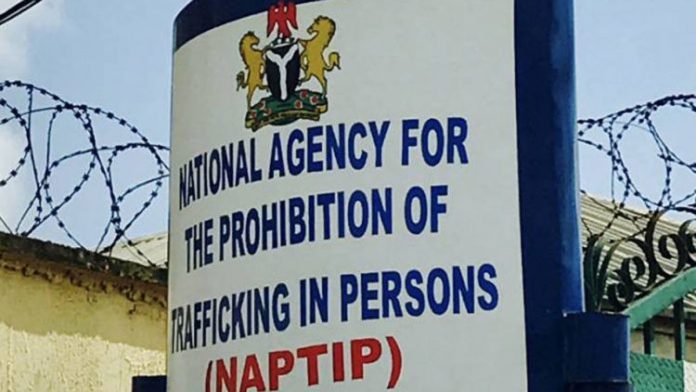
The National Agency for the Prohibition of
Trafficking in Persons has raised the alarm over the alleged use of civil society organisations as fronts by human traffickers to gain access to vulnerable communities and traffic children.
The agency said traffickers were increasingly exploiting communities affected by insecurity, including farmer-herder conflicts, by masquerading as representatives of non-governmental organisations and offering assistance to families.
The Head of Press and Public Relations of NAPTIP, Vincent Adekoye, disclosed this on Tuesday in Abuja while speaking at a joint press briefing of security spokespersons.
Adekoye said the agency had discovered that traffickers were approaching distressed communities under the guise of running educational and humanitarian programmes.
He said, “Traffickers also now masquerade under the umbrella of civil society organisations and move to communities that are already distressed; moving to communities where you have farmer-herder crises, and promising parents that, ‘Oh, we will take your children back to school,’ under a fake back-to-school project.
And from there, they harvest children, move them.”
According to him, NAPTIP recently rescued four children in Onitsha, Anambra State, who had allegedly been trafficked from Kajuru in Kaduna State in 2023.
He added that the agency recovered some of them inside a high-rise building, and one of those children also was recovered from a nurse at a Federal Medical Centre in Onitsha.
Adekoye said the agency was planning to profile CSOs, particularly community-based and faith-based organisations operating in vulnerable areas, to prevent criminal elements from exploiting their credibility.
He said, “We have continued also to ensure that we want to profile the Civil Society Organisations in Nigeria. My DG has asked me to convey to them, the leadership of the CSOs in Nigeria, to do an in-house cleansing.
“Because these are people that are known to the community. Some of them are community-based organisations, faith-based organisations, and non-governmental organisations. So, the people are familiar to them, so they take advantage of the vulnerability of the community—those who have been ravaged already—and they walk to them and take the children away.”
The NAPTIP spokesman said the agency had so far recovered 118 children allegedly trafficked from Nasarawa, Benue and three other states in the North-Central.
He urged Nigerians to be vigilant and report suspicious activities involving organisations seeking to take children away from their families.
“As of last count, we have recovered 118 of such children from those that were trafficked from Nasarawa and from Benue, and three other states within the North Central. So, we are appealing to Nigerians to be watchful. When you see them, please contact NAPTIP,” Adekoye said.
He further warned that human traffickers have now moved to the cyber space (social media) recruiting victims to Asia countries for hard labour.
According to him, the agency recently rescued 16 young boys from Thailand who were lured with attractive job offers.
He explained that the recruitment process was often designed to appear legitimate, with traffickers offering to arrange travel documents, transportation and other logistics for prospective victims.
“So, from beginning, it looks so real to them that they have no reason at all to doubt. So, the agency has been inundated of recent with calls from some of them who are stranded.
“Just in July, we rescued about 16 of them from Thailand. When you hear their story, your emotion will corrupt you of what they pass through. Some of them couldn’t survive. Those who survived have a narrow escape from death,” he said.