

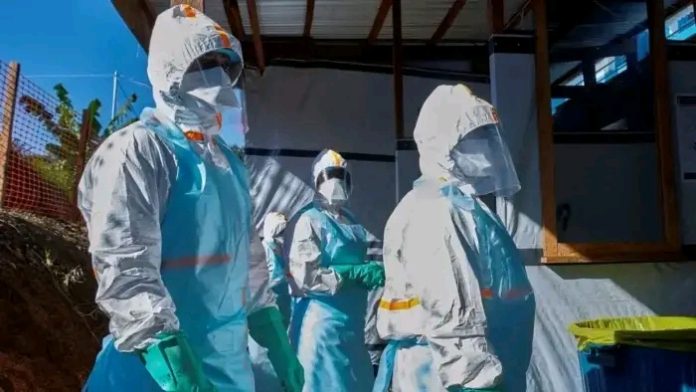
The World Health Organization said on Tuesday that it needs 5,000 additional health workers to help contain the Ebola outbreak ravaging the Democratic Republic of Congo, as the country’s health system buckles under the weight of a rapidly worsening crisis.
The outbreak, officially detected in mid-May, has spread to six provinces in the country’s conflict-plagued east and northeast, killing more than 3,175 people among over 6,600 confirmed infections, according to official Congolese figures cited by the WHO.
Health services in the affected regions lack sufficient staff and resources and have been overwhelmed by the surge in Ebola cases.
The virus, transmitted through contact with bodily fluids, can cause severe internal and external bleeding and organ failure.
The WHO said it hopes to create 3,000 beds for patients in Ebola treatment centres across the DRC, and Luca Fontana, a senior WHO technical official, told a press briefing in Geneva that more than 900 beds have been built in the response’s first two months, bringing the total to nearly 1,400 beds across 59 treatment centres.
Despite that progress, officials warn the gap remains wide. Fontana said another 1,600 beds will be required to meet the rapidly growing needs, and with three medical staff needed for each patient, that translates to training 9,000 health workers in total.
“Right now we have nearly 4,000 healthcare workers currently working inside the treatment centres. So it means we need 5,000 more,” Fontana said.
He further added that the health ministry in Kinshasa is racing against time to find suitable medical staff from other regions to bring into the affected provinces.
He explained that identifying candidates quickly enough to cover the growing need remains the central challenge, stressing that every fully staffed treatment centre means more lives saved and a stronger chance of bringing the outbreak under control.
The current epidemic is caused by the Bundibugyo strain, for which there is currently no approved vaccine or treatment, though several are being tested.