

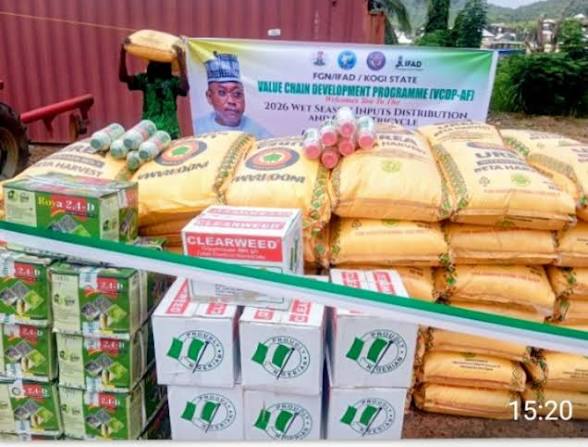
Kogi State Government has stepped up efforts to strengthen food security and boost agricultural productivity with the distribution of improved farm inputs and mechanisation equipment to 572 farmers across five local government areas under the Value Chain Development Programme of the International Fund (IFAD-VCDP)
The intervention, implemented through a partnership between the Kogi State Government, the Federal Government and IFAD is part of the 2026 wet season farming programme.
Speaking during flag off ceremony at the Agricultural Development Programme (ADP) headquarters in Lokoja,
the Commissioner for Agriculture and Food Security, Timothy Ojomah, described the distribution as a significant milestone in the state’s efforts to enhance food production, empower farmers and promote inclusive economic growth.
He said the initiative reflects the commitment of Governor Ahmed Usman Ododo to expand investment in agriculture, strengthening rural development and improving the livelihoods of farming communities across the state.
Ojomah noted that sustained investment in agriculture remains critical to achieving long-term food security, economic stability and prosperity, while commending IFAD for its continued partnership in improving access by farmers to quality inputs, climate-smart farming practices, agricultural value chains and rural infrastructure.
State Programme Coordinator of IFAD-VCDP, Dr. Stella Adejoh, praised Governor Ododo for the timely approval and release of the state’s 2026 counterpart funding, describing it as a demonstration of his commitment to sustaining the programme’s impact in Kogi state.
She said the distribution goes beyond the provision of farm inputs and equipment, representing a shared commitment to improving the livelihoods of smallholder farmers, creating jobs, strengthening food security and accelerating agricultural transformation.
According to her, the 572 beneficiaries were selected from Ajaokuta, Ibaji, Kabba/Bunu, Lokoja and Olamaboro Local Government Areas.
The beneficiaries received improved rice and cassava production inputs, alongside mechanisation support comprising 42 mini cargo tricycles and six heavy-duty cargo tricycles to ease farm operations and the transportation of produce.
Dr. Adejoh urged the beneficiaries to make effective use of the intervention to increase production, build sustainable agribusinesses, generate employment and improve household incomes.
Representative of the National Coordinator of IFAD-VCDP, Hamza Shehu, said the support would boost agricultural productivity, expand farmers’ incomes, strengthen the resilience of farming households and improve the socio-economic wellbeing of rural communities.
He added that the improved rice seeds and fertilisers would enhance yields during the 2026 wet season, while the cargo tricycles would reduce post-harvest losses by improving the movement of farm inputs and harvested produce to markets.