

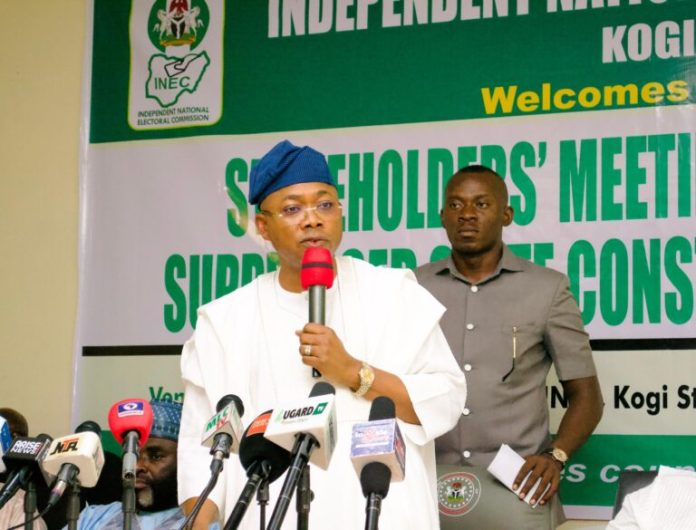
Kogi State Governor, Ahmed Usman Ododo, has commended the Independent National Electoral Commission (INEC) for what he described as a bold demonstration of institutional integrity and commitment to the rule of law, as efforts to restore suppressed state constituencies in the state gains momentum.
The Governor gave the commendation at a high-level stakeholders’ meeting on the restoration of suppressed constituencies at the INEC’s office in Lokoja, the state capital.
He praised INEC for aligning its actions with the Federal High Court ruling and constitutional provisions guiding electoral representation.
Ododo expressed appreciation to the INEC Chairman, Joash Amupitan, for his courage and professionalism, noting that the Commission’s actions have helped restore public confidence in Nigeria’s electoral system.
“Your actions, in line with the Federal High Court ruling and in accordance with the Constitution, stand as a commendable example of institutional integrity and respect for the rule of law,” the Governor stated.
He further commended President Bola Ahmed Tinubu for appointing a “man of impeccable character” to lead the nation’s electoral body, stressing that the decision is already strengthening democratic institutions and deepening internal democracy without undue interference.
“This singular decision continues to yield dividends for our democracy and for the strengthening of our national institutions,” Ododo said, adding that the President also deserves credit for allowing the judiciary to perform its constitutional role without interference.
Describing the constituency restoration process as far more politics, the Governor emphasized its significance in correcting historical imbalances and amplifying marginalized voices.
“This process is not merely a political exercise; it is a restoration of constitutional order. It gives voice to the previously unheard and restores confidence in the system. It is, in every sense, a victory for democracy and for the people,” he declared.
He assured INEC and other stakeholders of the state government’s full cooperation, including the provision of adequate security and logistical support to ensure a seamless exercise across the state.
Earlier, the Resident Electoral Commissioner (REC) in Kogi State, Shehu Abdulwahab, said the Commission is seeking the cooperation of all stakeholders to achieve its objectives, stressing that inclusive engagement remains critical to the success of the exercise.
Also speaking, the Supervising National Commissioner for Kogi, Benue and Kwara States, Prof. Sani Adams, explained that the meeting was convened to address longstanding concerns over suppressed constituencies and to ensure compliance with court rulings.
He noted that constituencies are fundamental to bringing governance closer to the people and reaffirmed INEC’s commitment to implementing the restoration process in line with legal and constitutional provisions.
Adams highlighted the strategic importance of Kogi State in national development, adding that the Commission is empowered by relevant sections of the Constitution to carry out constituency delineation exercises pursuant to equitable representation.
Legal representatives from affected constituencies argued that Kogi State currently operates below its constitutional entitlement, noting that while the state ought to have 36 state constituencies, it presently has only 25—an imbalance they say contradicts Section 91 of the 1999 Constitution.
They further referred to constitutional provisions mandating INEC to divide states into constituencies in a manner that ensures fair and effective representation, insisting that the current structure undermines equity in representative democracy.
The stakeholders’ meeting comes on the heels of earlier engagements between the Kogi State Government and concerned groups advocating the restoration of suppressed constituencies in the state house of assembly.
Governor Ododo had previously assured petitioners of a thorough, legally guided review of their demands, emphasizing compliance with due process and constructive engagement.
The agitation traces its roots to the 1991/1992 delineation exercise, which stakeholders argue led to the suppression of several constituencies, resulting in unequal representation across the state’s senatorial districts.