

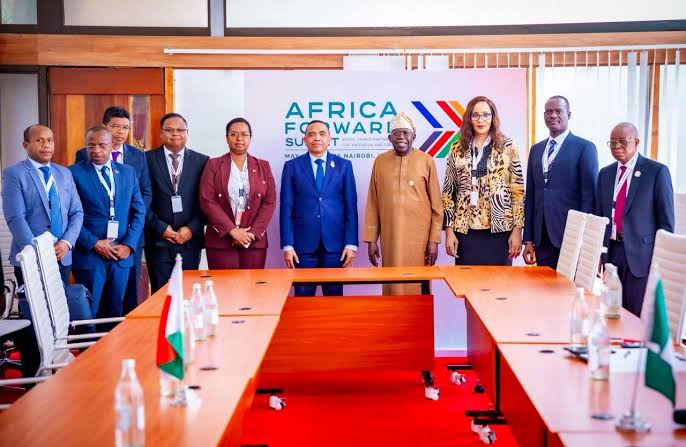
President Bola Ahmed Tinubu said Africa must move from “sea blindness” to “ocean sovereignty” to position maritime governance and security as the foundation for unlocking the continent’s blue economy potential.
The President’s demand comes amidst over the dominance of the continent’s waterway security architectures by foreign powers.
Speaking at the High-Level Roundtable on Maritime Sovereignty and Ocean Governance during the Africa Forward Summit 2026 in Nairobi, Kenya, yesterday, Tinubu said Nigeria had transformed its maritime strategy from one focused largely on threats to one centred on economic opportunity, regional security and investment.
In a statement signed by the Special Adviser to the Minister of Marine and Blue Economy, Dr Bolaji Akinola, the President said sea blindness had caused Africa to view the vast waters under its jurisdiction as voids or merely as sources of threat.
“Nigeria is here to tell a different story: our maritime domain is a sovereign territory, and its governance must be asserted, resourced and institutionalised,” Tinubu stated.
The President said maritime sovereignty is an economic imperative for Africa’s future, insisting that secure sea lanes and predictable regulation were necessary conditions for attracting private capital into the blue economy.
Tinubu also said that piracy incidents had been eliminated within Nigerian waters following sustained investments in maritime security infrastructure under the country’s Deep Blue Project.
He said the initiative deployed an integrated network of intelligence, surveillance and reconnaissance assets, including command-and-control centres, special mission vessels, fast intervention boats and aerial platforms.
Tinubu stated that the global maritime community has acknowledged the elimination of piracy incidents within Nigerian waters and the substantial reduction of attacks across the Gulf of Guinea.
He also highlighted Nigeria’s recent institutional reforms, including the creation of a dedicated Ministry of Marine and Blue Economy, describing it as proof that ocean governance had become a central pillar of state policy.
The President called for deeper regional coordination across the Gulf of Guinea, warning that maritime crime cannot be effectively tackled by countries acting in isolation.
“As we endorse the Nairobi Declaration, Nigeria affirms that maritime sovereignty and ocean governance are the non-negotiable foundations of Africa’s blue economy transformation,” he said.
Tinubu concluded by urging African states to treat ocean governance as a generational responsibility, declaring that “the oceans have no duplicate as a common heritage of mankind.”